
Boundary County Court Records After Arrest
After a Boundary County arrest, the first record is usually a sheriff, jail, or arresting-agency record. The court record starts later, when the Boundary County Prosecuting Attorney files a criminal charge for the State of Idaho or Boundary County. Official county material names Andrakay J. Pluid as the Boundary County Prosecuting Attorney, with Tevis Hull as Chief Deputy Prosecuting Attorney. That office is the charging office, but it is not the jail roster custodian and it is not the court clerk.
The practical path is arrest, booking, first appearance, prosecutor review, then a case record in Idaho's court system. Boundary County was included in Idaho iCourt's Wave 2 transition on April 9, 2018, so newer public case information is searched through iCourt. For custody or booking details, use the Boundary County jail inmate records route. For booking photos, use the Boundary County jail mugshots page because the court case file is not a mugshot gallery.
Find Boundary County Court Records
Use Idaho iCourt public search guidance for basic case information after a Boundary County arrest. iCourt can show case information, parties, charge details, bond information, disposition events, other hearings, and financial information when those tiles apply and the case is public. The system is a court-record tool, not a local jail roster. A case may not appear if no charge has been filed yet, if the search terms are off, if the case is sealed or exempt, or if the record must be requested from the clerk.
- Search by full record or case number when known, such as the CR-style format described in the iCourt tutorial.
- Search a party name in last-name, first-name format when the case number is not known.
- Use a wildcard only when the tutorial format fits, with at least four letters followed by an asterisk.
- Open the case detail tiles for charge, bond, hearing, disposition, and financial information.
- Request clerk copies when the public portal does not show the document needed.
The official tutorial also explains that print options can be limited to selected case-detail tiles. That matters for a Boundary County arrest because a person may need only bond information, a charge list, or a disposition event, not every available tile.
| iCourt Field | How to Use It | Boundary County Note |
|---|---|---|
| Smart Search | Search by case number or party name. | Best first stop for filed charges after arrest. |
| Record/case number | Use full case number if known. | Older cases may need clerk help. |
| Party name | Use last name, comma, first name. | Spelling and name changes can affect results. |
| Wildcard | Use at least four letters and an asterisk. | Useful when a name is uncertain. |
| Select the tiles needed. | Printed tiles are not certified court copies. |
Boundary County iCourt Records
The official iCourt public search tutorial is the most direct visual match for searching court records after a Boundary County arrest.
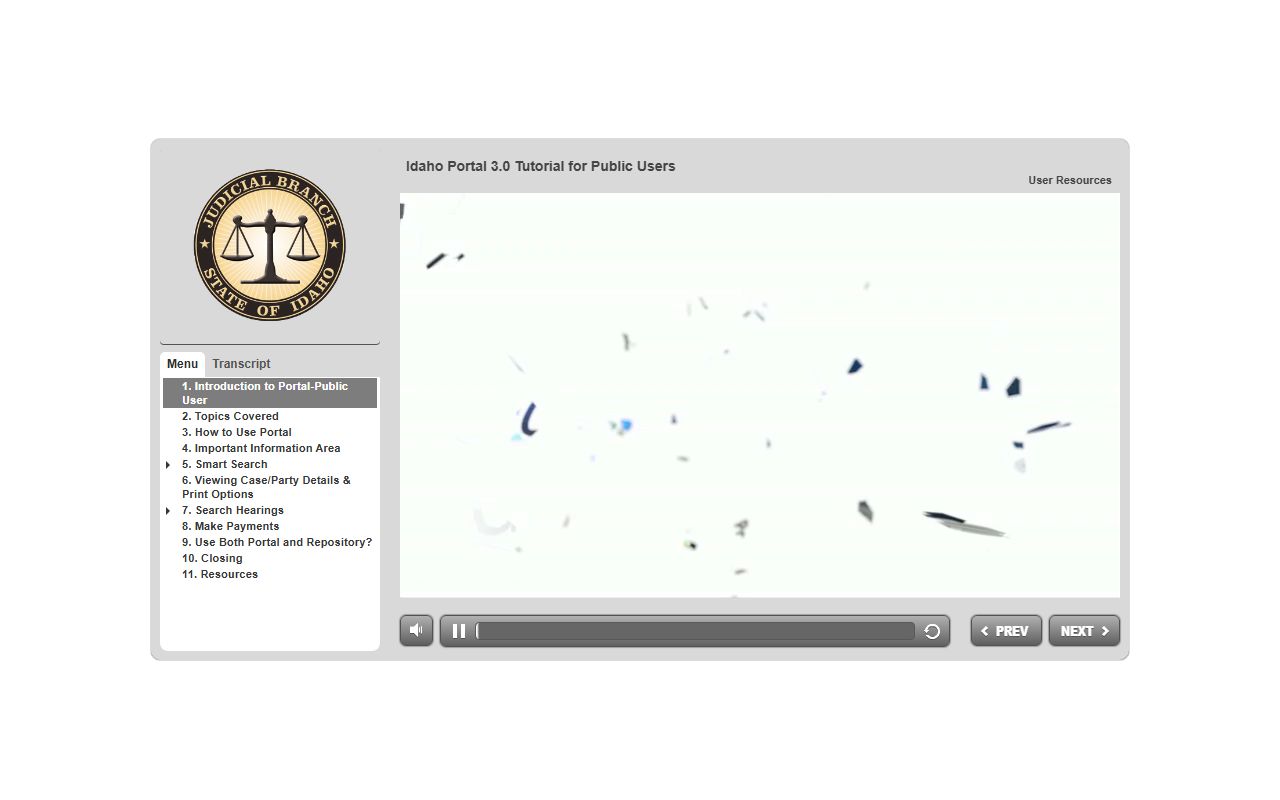
The tutorial screenshot supports the case-search steps above because it shows the statewide search environment used for charge details, bond information, hearings, and dispositions.
Boundary County Court Copy Requests
When online case information is not enough, use the Boundary County court records request form. The form is built for documents, certified documents, and audio. It asks for the requester's name, mailing address, phone number, optional email, case number, case title, specific documents or hearing dates, delivery method, and a reason or relationship for exempt, sealed, or confidential records.
The form prints local fee fields. Pages are listed at $1.00 per page, certifications at $1.00 per stamp, and audio at $10 per flash drive. It also notes that additional fees may apply under Idaho Code 74-102 when a request is large, requires redaction, or takes more than two person hours. Requesting electronic delivery can help, but the form still allows pick-up, email, or mail, and mail can add postage.
| Request Type | What to Include | Why It Matters |
|---|---|---|
| Documents | Case number, case title, and exact documents. | Specific requests are easier to locate and price. |
| Certified documents | Same fields plus certification request. | Needed for many official uses. |
| Audio | Hearing date and case details. | The form references MP3 on USB flash drive. |
| Sealed or exempt review | Reason and relation to the case. | A reason field does not guarantee access. |
Boundary County Court Charges
Jail booking charges can be early allegations. The filed court charges are the prosecutor's charges, and they can differ from the booking line that jail staff used at intake. The Boundary County Prosecuting Attorney page describes the office as the elected charging office for accountability on behalf of the public and the State of Idaho. That role is why formal complaints, informations, amendments, dismissals, and dispositions belong in court records after an arrest.
| Document | Who Uses It | What It Does |
|---|---|---|
| Complaint | Officer or prosecutor | Starts many criminal cases and states the alleged offense. |
| Information | Prosecutor | Sets out prosecutor-filed charges, often in felony proceedings. |
| Indictment | Grand jury | Charges an offense after grand-jury action in serious cases. |
Charge path: Arrest record to jail booking to prosecutor filing to iCourt case. The court case is the place to check formal charge status.
Boundary County Court Charge Status
A charge is not frozen on the day of arrest. Prosecutors may add counts, reduce a charge, amend language, dismiss a count, or proceed to plea, trial, or sentencing. iCourt case details can include charge details, disposition events, hearings, and bond information, but a sealed or exempt case may not return public results. For certified status, use the clerk rather than a screen print.
| Status | Plain Meaning | Record Caution |
|---|---|---|
| Pending | The charge has been filed and remains open. | Hearings, bond, and conditions may change. |
| Amended | The filed charge text or count has changed. | Do not rely only on the first booking allegation. |
| Reduced | The charge level or offense has been lowered. | The disposition tile may explain the final result. |
| Dismissed | The count or case is no longer being prosecuted in that form. | Dismissal is not the same as automatic erasure of all records. |
| Disposed | The court has reached an outcome for that charge or case. | Use certified records for official proof. |
Boundary County Bond Court Records
Boundary County bail questions often require both jail and court checks. The sheriff jail page routes after-hours bail through dispatch non-emergency at 208-267-3151 and says cash is generally accepted while checks generally are not. Once a case exists, iCourt may show bond information. A court order can change release conditions, and a separate hold can delay release even when local bail is posted.
| Bond or Hold | How It Works |
|---|---|
| Cash bond | Money paid in the amount accepted by the jail or court after staff confirms current terms. |
| Surety bond | A bail agent posts bond when allowed by the court and current law. |
| Personal recognizance | Release based on a promise to appear and comply with court conditions. |
| No-bond hold | Payment alone will not release the person until a court or holding agency acts. |
No official Boundary County active-warrant web list was located. The sheriff Civil Processing division serves civil and criminal legal documents, including warrants in its service role, but that is not a public warrant search. The iCourt tutorial says unsealed warrants and no-contact orders may be searched by record number. For case-related warrant records, use iCourt or the Boundary County court clerk at 208-267-5504. For a local custody check, call the jail or sheriff office.
Boundary County Records Comparisons
Boundary County court records after arrest can be misunderstood because the same case may show an arrest, a filed charge, a bond order, and a final result. Each term means something different. A charge is an accusation. A conviction follows a plea or verdict. Sealing, shielding, or set-aside relief can limit public access, but it does not automatically rewrite every sheriff, court, state, or commercial copy.
| Question | Charge | Conviction |
|---|---|---|
| Stage | Filed accusation after arrest. | Final finding after plea or verdict. |
| Proof level | Not proof of guilt. | Court outcome based on plea or proof. |
| Where to check | iCourt charge details. | Disposition events, judgment, or certified record. |
| Question | Sealed or Shielded | Expunged or Set Aside |
|---|---|---|
| Public view | Public access may be limited under rule, law, or order. | Relief may change court status when a person qualifies. |
| Main authority | Idaho Court Administrative Rule 32 and related criminal-history shielding rules. | Idaho Code 19-2604 for qualifying dismissal or set-aside relief. |
| Limits | Some agencies may retain lawful access. | It is not automatic removal of every jail or law-enforcement record. |
Restricted Boundary Court Records
Public access rules differ by custodian. Sheriff and jail records are controlled by Idaho public-records law, including Idaho Code 74-124 for law-enforcement records. Court records are governed by ICAR 32. That split matters in Boundary County because the sheriff records department says court records are handled by the courts, city police records are handled by city police, reports may not be available the same day, and open investigations are not released until closed.
Juvenile information, victim and witness details, sealed cases, shielded records, medical or privacy information, and active investigative material may be withheld or redacted. Idaho Code 74-103 also governs public-agency timing and written notice when more time is needed or access is denied. For court files, the clerk form's reason and relation field is important for exempt or confidential material, but it does not create a right to see a record that the law protects.
Important: Consumer reports for credit, employment, housing, insurance, or similar purposes require FCRA-compliant sources, not casual court lookup results.